
Criminal Cases in the Jefferson County Courts
Jefferson County criminal court cases divide by charge level. The Criminal District Court and 252nd District Court are the principal felony dockets at 1085 Pearl Street in Beaumont. The District Clerk keeps the pleadings, docket, judgment, and sentence for those filed cases. County Courts at Law Nos. 2 and 3 hear filed Class A and Class B misdemeanors under local assignments, and the County Clerk maintains those records. Current assignments should be checked because Jefferson County local administrative rules can change which court receives a docket.
Fine-only Class C cases and city ordinance matters remain with the municipal court that issued them. Justice courts keep matters filed within their own jurisdiction. This division explains why a name may yield no result at the Pearl Street county counter even though a municipal warrant or JP case exists. Cause numbers seen in public schedules often use forms such as YYDCCR#### for felony dockets and YYCCCR#### for misdemeanor dockets. The code helps identify the court system, but the clerk should confirm the file.
Jefferson County Criminal Court Directory
The Texas Office of Court Administration directory is the best current source for Jefferson County court names, addresses, judges, and contact lines. It is a directory, not a case-search engine. Use it to identify the right criminal court before asking a clerk for a docket or file. The Criminal District Court lists 409-835-8432, the 252nd District Court lists 409-835-8597, and County Court at Law No. 2 lists 409-835-8429.
The official directory results show why a broad request to “the courthouse” is too vague.
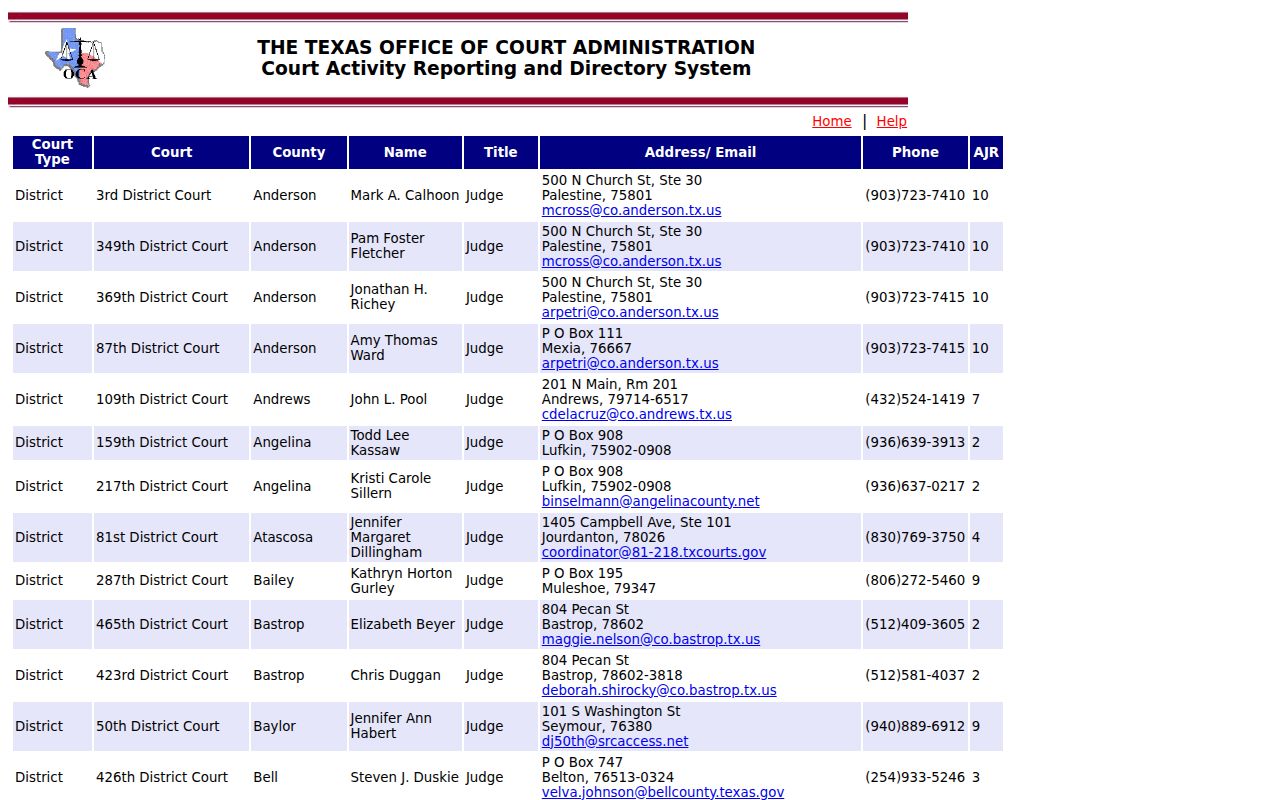
That court-by-court list lets a reader route a Jefferson County criminal case to the custodian that can actually produce it.
How to Search Case Records
Because the public Odyssey site is unavailable, a sound Jefferson County criminal case search uses clerk contacts and courthouse terminals first. Start with a cause number if one is known. A full name, filing year, offense class, and court can help separate similar names. Do not assume re:SearchTX contains every local criminal filing; access and document coverage vary, and Texas has no single Judicial Branch search for all trial courts.
- Classify the matter as a felony, Class A or B misdemeanor, or municipal or JP offense.
- Contact the District Clerk for felonies or the County Clerk for filed Class A and B misdemeanors.
- Search by cause number when possible, or provide the party name and a useful filing-date range.
- Read the docket status and entries, then ask which public documents are imaged or available at a free terminal.
- Order a plain or certified copy from the clerk that holds the original Jefferson County criminal case file.
The disabled Odyssey interface still documents the controls intended for its Jefferson County court search. For filed Class A and Class B misdemeanors, the County Clerk criminal search form costs $10, is nonrefundable, and covers January 1, 1982, forward. It excludes JP matters, municipal citations, cases never filed by the prosecutor, and cases from other counties.
| Field or Control | Type | Required | Use |
|---|---|---|---|
| Party | Text | One search key | Name-based lookup when public access returns |
| Cause Number | Text | Alternative | Most direct match to a filed case |
| Date Range | Date pickers | No | Narrows filing or recording dates |
| Record Type | Dropdown | No | Options depend on the selected clerk index |
| Search / Clear | Buttons | N/A | Runs or resets the stated criteria |
Jefferson County Odyssey Court Fallbacks
The official Jefferson County Odyssey portal currently states that public access is not available through the portal. It describes free view-only access and searches by party, cause number, or date, but the live notice limits the environment to attorneys with Jefferson County cases. Public readers should not treat a blank or blocked portal screen as a no-case result.
The current Odyssey notice is the reason the fallback chain matters.
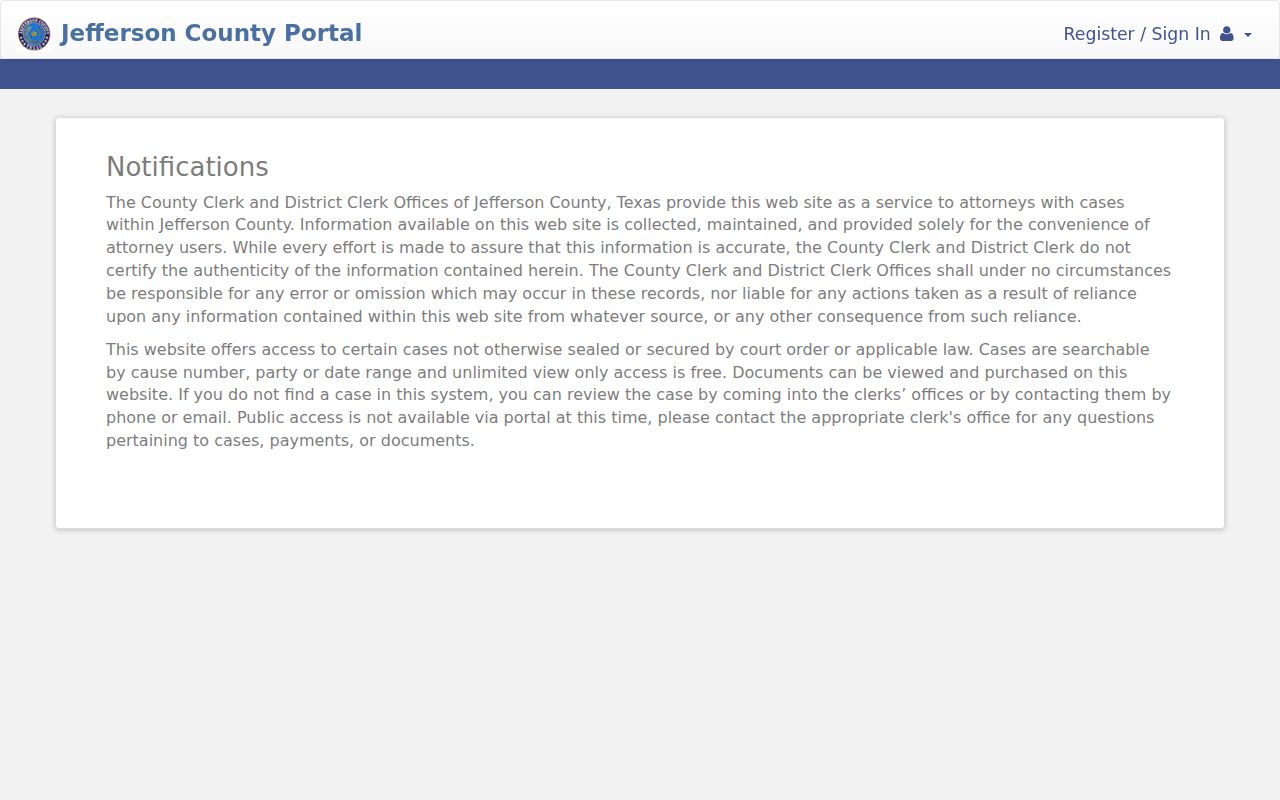
Use the District Clerk's free public terminals, call or email the proper clerk, and inspect official docket PDFs while remote public access remains disabled. The District Clerk is at 1085 Pearl Street, Room 203, Beaumont, Texas 77701, at 409-835-8580; criminal information is available at 409-835-8538 and districtclerk@jeffersoncountytx.gov. The County Clerk accepts its separate misdemeanor-search form for qualifying cases.
Note: Texas OCA can identify a court, but it cannot search or issue the Jefferson County criminal case record for that court.
What the Case File Shows
A Jefferson County criminal case file begins when prosecutors file an information, indictment, or other charging paper. It then grows through docket entries, motions, settings, pleas, trial events, judgment, and sentence. Public docket sheets may also show counsel, bond entries, a capias, costs, and a hearing type. A schedule is only a snapshot of planned court work, while the filed judgment and docket establish the recorded result.
| Cause Number and Court | Identifies the filed Jefferson County case, assigned court, and charge sequence. |
|---|---|
| Charging Document | States the offense prosecutors actually filed, including degree, class, and count. |
| Docket Entries | Dates filings, settings, pleas, motions, judgments, sentences, and capias activity when entered. |
| Parties and Counsel | Names the State, defendant, and public attorney information where available. |
| Disposition and Judgment | Records the court outcome, which may differ from the original arrest allegation. |
| Sentence and Ledger | Shows punishment, supervision terms, fines, costs, or other financial entries when public. |
Victim data, juvenile material, sealed files, and protected personal identifiers may be omitted or redacted. Document images appear only when the clerk has imaged and released them.
Reading Jefferson County Criminal Dockets
Official Jefferson County docket PDFs use short labels that describe a setting, not always a final outcome. “Initial” can mark an early appearance. “Announcement” or “Pretrial” identifies a scheduled stage. “Plea” indicates a plea setting, while “Trial” marks a trial setting. “MTRP” commonly refers to a motion to revoke probation, and a capias is an order directing custody in a filed case. Check later docket entries and the judgment before drawing a conclusion.
- Disposition
- The recorded result of a charge, such as conviction, acquittal, or dismissal.
- Capias
- A court order directing that a person be taken into custody in the filed case.
- TRN or Cycle
- A tracking reference that can connect a reported arrest event with prosecutor and court reporting.
- Deferred Adjudication
- A plea-based outcome in which the court defers a finding of guilt while supervision is completed.
A jail-status flag or active-warrant field on one schedule can change. Confirm it with the issuing court rather than treating an old PDF as live operational proof.
Stages of a Criminal Case
A Jefferson County criminal case may begin after a local arrest, but the court file does not exist until a prosecutor accepts and files a charge. Felonies may proceed by indictment; misdemeanors may proceed by information. At arraignment, the defendant receives the filed accusation and enters a plea. Pretrial work can include motions, evidence issues, bond questions, discovery, and negotiation. A plea or trial then leads toward a recorded disposition.
Case flow: Charges Filed › Arraignment › Pretrial › Plea or Trial › Disposition › Sentencing
Later filings can include an appeal or a motion concerning community supervision. The docket date alone does not prove that an event occurred as first scheduled, so read the next entry and obtain the signed order or judgment.
Jefferson County Charges Can Change
The arresting officer's allegation, the prosecutor's filed offense, and the final Jefferson County judgment answer three different questions. Police describe probable cause at arrest. The Jefferson County Criminal District Attorney may reject the referral, reduce or enhance a charge, or file a different offense. The court file then records what happened to each filed count. That is why an arrest entry can exist even when the County Clerk's paid search returns nothing.
Class codes also require care. CF, F1, F2, F3, FS, MA, MB, and MC describe offense levels at a given stage. They do not prove guilt. Texas Penal Code Chapter 12 supplies the punishment classes, while repeat-offender rules can alter the range. For a sound Jefferson County court-record reading, rely on the filed charge and signed judgment rather than a roster abbreviation. The related Jefferson County arrest history can help locate the earlier booking without replacing the court result.
Access & Restrictions
Public Jefferson County criminal case records remain subject to court law, clerk rules, confidentiality statutes, and sealing orders. Texas Rule of Judicial Administration 12 governs judicial records, but filed case records are obtained from the proper clerk under court law and rules. The Texas Public Information Act should not be treated as the sole access rule for a judicial case file.
The District Clerk's archive plan reports millions of records dating to the mid-1800s, with imaging begun in 2000 and a large paper backlog from 1992 forward. An absent image may mean the paper file has not been scanned. County Clerk misdemeanor index data update three times daily, but online images are not promised. When a valid file is not visible, provide the cause number and ask for inspection or a copy.
Jefferson County Criminal Case Copies
Request a copy from the clerk that maintains the Jefferson County criminal case. The County Clerk charges $1 per page for noncertified copies. A certified copy adds a $5 certificate per document plus $1 per page. Accepted payment methods include major cards, cash, personal check, or money order, and the stated card convenience fee is 2.95 percent. Never email a card number or mail cash.
Certified copies are useful when the seal and clerk's certification matter. For ordinary research, a plain copy may be enough. State whether the request seeks the charging instrument, docket sheet, judgment, sentence, or a named motion. That narrower description helps the clerk find the right item and avoids paying for pages that do not answer the question. Older misdemeanor matters before the County Clerk form's January 1, 1982 coverage date require a direct archive inquiry.
Note: A clerk-certified judgment carries the court result; a booking page or public schedule does not serve as its substitute.